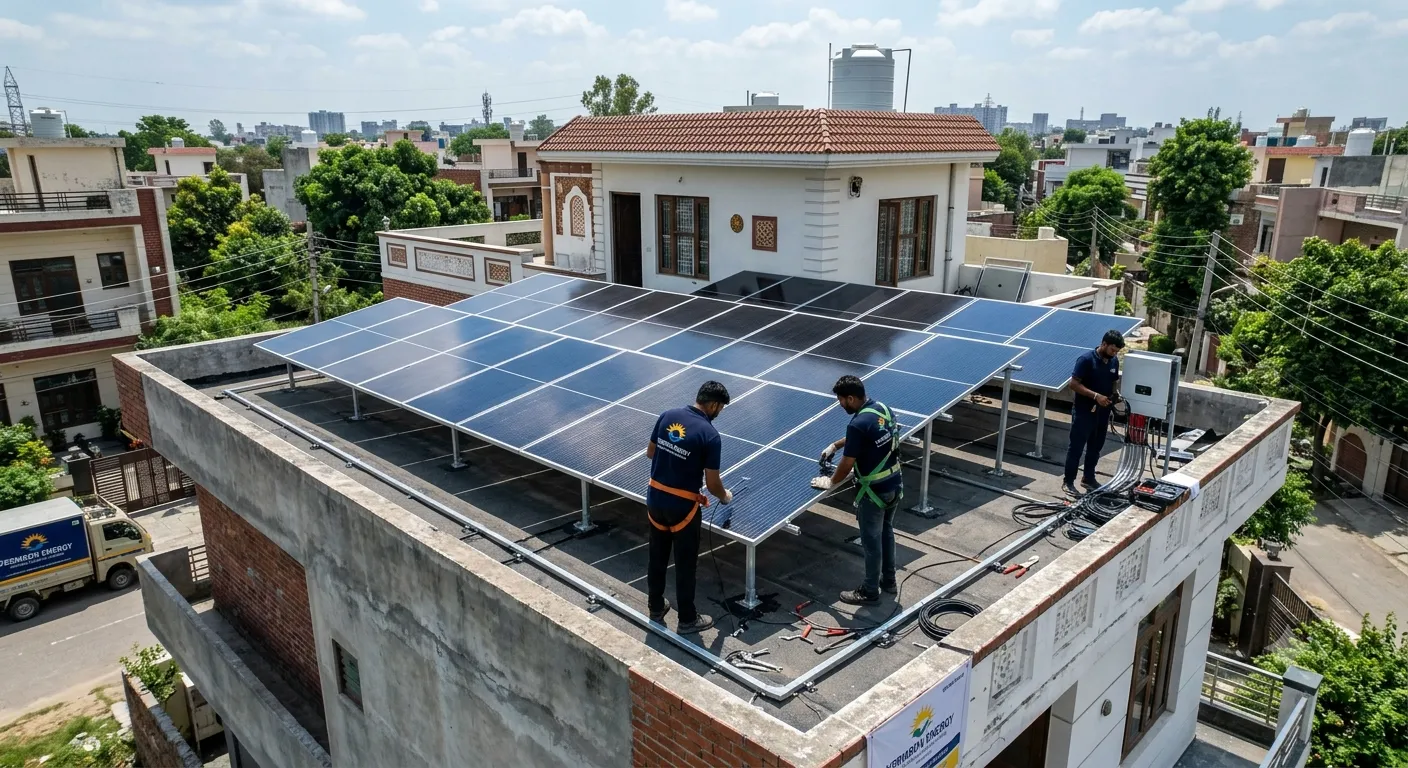
If you run a factory, rice mill, cold storage or any commercial unit in Punjab, Haryana or UP, your electricity bill is likely your single largest operating expense after raw materials. At commercial tariffs of ₹7–9 per unit, a medium-sized facility spending ₹3–5 lakh a month on electricity can expect to cut that bill by 40–60% permanently with the right solar installation.
Why Industrial Solar Makes More Financial Sense Than Residential
The maths is simple: commercial solar doesn't qualify for PM Surya Ghar subsidy, but it gets something arguably better — 40% accelerated depreciation under the Income Tax Act. For a company in the 22–30% tax bracket, that translates to a ₹8–12 lakh effective tax saving on a ₹50 lakh installation.
Real Numbers: 100 kW Plant at a Rice Mill
| Parameter | Value |
|---|---|
| System capacity | 100 kW |
| Monthly generation | ~11,700 units |
| Commercial tariff saved | ₹8.50/unit |
| Monthly savings | ~₹99,450 |
| Annual savings | ~₹11.9 lakh |
| Installation cost (₹40k/kW) | ₹40 lakh |
| Tax benefit (40% AD, 25% bracket) | ~₹10 lakh |
| Net cost after tax | ~₹30 lakh |
| Simple payback | ~2.5 years |
What About Seasonal Production Drops?
North India sees a ~15% generation dip in December–January due to shorter days and occasional haze. June–September monsoon months reduce output by 10–20%. We design systems with a 10–15% oversize factor to compensate, ensuring annual generation targets are met.
Ground-Mounted vs Rooftop for Industrial Sites
- Rooftop: Lowest cost, no land required. Ideal for flat RCC roofs on factories and warehouses. Standard for 50–500 kW.
- Ground-mounted: Better yield (optimal tilt angle), easier cleaning. Viable where 1–2 acres of unused land is available. Cost is 10–15% higher.
- Carport / shed solar: Dual-use — shades vehicles or parking, generates power. Popular for cold storage and logistics parks.
Net Metering for Industrial Units
Under net metering, surplus power you don't consume is exported to the DISCOM grid and credited to your account. For industrial units with consistent daytime loads (motors, compressors, cooling), utilisation rates are typically 85–95% — meaning very little goes to waste.
Getting Started
The process is straightforward: site survey → energy audit → system design → fixed-price proposal → installation → DISCOM commissioning. Vermson India has commissioned over 25 industrial solar plants across Punjab and Haryana, including rice mills at Ludhiana, Malerkotla and Sangrur. We handle every DISCOM form, load-sanctioning request and net-metering application.